Geppetto
Pinocchio (Tania Zamorsky Edition)Geppetto is Pinocchio’s father, a woodcarver whose care is measured less by promises than by what he gives up and endures. He first appears as an energetic but quick-tempered old man; later, poverty strips him of his coat, and his search for his missing son carries him across the sea and into the Great Shark. Their reunion and escape reverse the earlier pattern of a father trying to guide a wayward child: at last, Pinocchio carries Geppetto to safety.
Identity and First Appearance
Geppetto enters a carpenter’s workshop as a sprightly old man. The neighborhood boys call him Polendina when they want to provoke him, mocking his yellow wig, which resembles corn polenta. The nickname is a source of genuine anger: Geppetto is described as irascible, and hearing it makes him flush with fury. This comic introduction establishes a sharp contrast between his lively presence and the poverty that will shape his family life.
His first stated project is to make a remarkable wooden puppet, one able to dance, fence, and perform somersaults. Geppetto imagines traveling the world with the puppet and earning enough for bread and a glass of wine. The plan is both practical and fanciful: the puppet is meant to be a livelihood, but the skills Geppetto imagines for it promise spectacle and movement. His ambition begins not with comfort for himself, but with a means of getting by through the work and performance of the figure he hopes to create.
A Father’s Sacrifice
When Pinocchio needs a primer, Geppetto goes out wearing his old fustian jacket, patched and mended all over. He returns with the book but without the jacket, in his shirtsleeves while snow is falling. The missing garment makes the cost of the purchase plain. Geppetto has surrendered his own protection against the weather so that his son can have a chance to study.
The episode gives material form to the relationship between them. Geppetto’s care is not abstract: it is a book in his hand and an absent coat in the cold. Pinocchio recognizes the loss and asks about it, while the surrounding poverty is presented as something even a child can understand. The father’s sacrifice also establishes a standard against which Pinocchio’s later conduct can be measured. Geppetto provides what he can, even when doing so leaves him exposed.
The Search Across the Sea
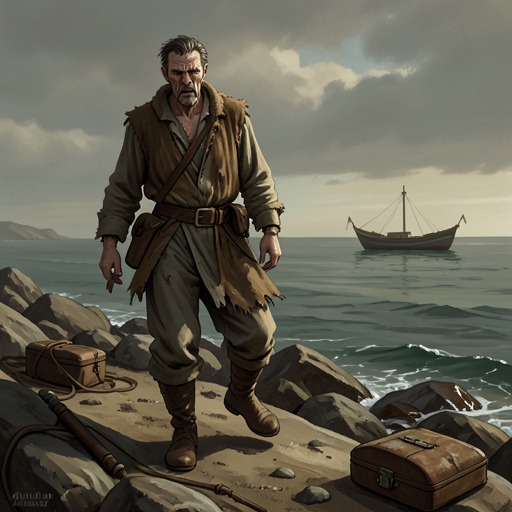
Geppetto’s devotion continues after Pinocchio disappears. More than four months into his search, he has traveled the world without finding his son. He is last seen on a beach, building a small boat so he can cross the Ocean and continue the search in distant lands. The scale of the undertaking is made concrete when Pinocchio learns that the beach is more than a thousand kilometers away. Geppetto’s absence from the story is therefore not a withdrawal from fatherhood; it is the consequence of pursuing it over an immense distance.
Pinocchio eventually tells Geppetto how the Blue-Haired Fairy sent for him and how a dove carried him through the night toward his father. From far off, Pinocchio recognized Geppetto in the boat and tried to signal him back to shore. Geppetto recognized his son too and wanted to return, but the sea was rough. A great wave overturned the little boat, and the nearby Great Shark swallowed him. Their separate attempts to close the distance between them thus meet in a catastrophe: Pinocchio reaches the shore, while Geppetto is carried away inside the sea creature.
Reunion and Escape from the Great Shark
Pinocchio finds his father deep inside the Great Shark, where a small table is set with a candle burning in a green glass bottle. Geppetto, white-haired and white in appearance, sits there eating tiny live fish, some of which slip out of his mouth. The strange domestic scene makes his survival visible: even within the monster, he has arranged a place to sit and a light by which to live. Pinocchio’s response is an overwhelming rush of joy. He struggles to speak, then throws his arms around Geppetto and declares that he will not leave him again.
Geppetto has been imprisoned there for two years, which he says have felt like two centuries. His account reveals that the same storm that overturned his boat also sank a merchant ship; after swallowing Geppetto, the Great Shark swallowed the vessel as well. The swallowed ship helps explain the resources available inside the creature, while the two-year span gives the reunion its weight: father and son recover one another after a separation lasting far longer than either could have intended.
Escape requires a reversal of their usual positions. Pinocchio takes Geppetto by the hand and leads him along the Great Shark’s throat, across its tongue, and over three rows of teeth. Before they jump, Pinocchio tells his father to climb onto his shoulders and hold tightly. He then plunges into the water and swims, carrying Geppetto as the Great Shark sleeps. The sea is calm, and the moon shines brightly as Pinocchio makes for shore. The child who once depended on his father now becomes the one who bears him through danger.
Homecoming and Significance
After Pinocchio becomes a real boy, he finds Geppetto healthy, lively, and in good spirits. The old man has resumed his trade as a woodcarver and is designing an elaborate frame decorated with leaves, flowers, and the heads of different animals. This return to work supplies a concrete image of restored domestic life: Geppetto is no longer lost at sea or confined inside the Great Shark, but once again making things at home.
Geppetto tells Pinocchio that the sudden improvement in their household is all due to his son. The statement connects Pinocchio’s change with the restoration of the family without turning Geppetto into a mere reward for good behavior. Across the story’s decisive hardships, he remains the father who imagines a livelihood, gives up his coat for a primer, and risks everything to search for his child. The reunion completes that long movement of care: Geppetto once made plans to bring Pinocchio into the world, and, when their positions are reversed, Pinocchio carries Geppetto back toward home.